
 The Global Gulf |
 October 4, 2026 |
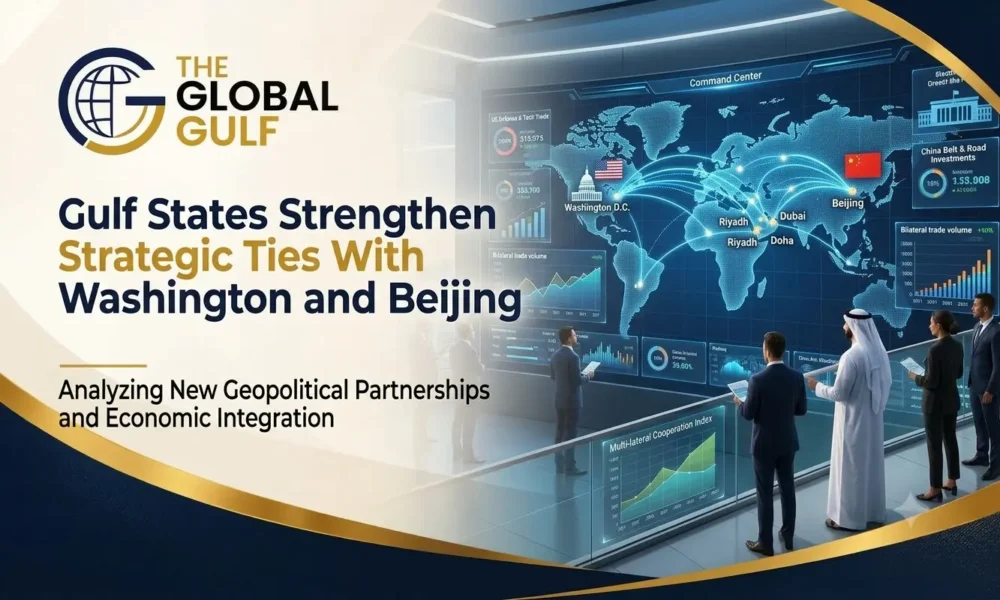
The red-carpet welcome given to Chinese leader Xi Jinping in Washington last week stood in contrast to the modest policy results of his meetings with US president Donald Trump. According to Tim Fox, a partner at Capital Gate Advisors and a former chief economist of Emirates NBD, the more telling message is that neither capital expects the rivalry to fade. Both appear to be looking for ways to manage it. For the Gulf states, that matters a great deal.
A Limited Outcome in Washington
There was some progress. The two sides extended their trade truce, agreed more favourable tariff treatment on $30 billion of goods in each direction and set up a dialogue on artificial intelligence. Yet the main disputes over technology, critical minerals, trade imbalances and Taiwan remain unresolved.
No Need to Choose
For much of the past decade, growing US-China rivalry has raised a recurring question: would Gulf countries eventually have to pick a side? Fox argues that the answer increasingly appears to be no. Instead, the region is building its own model of strategic economic engagement, keeping its long-standing ties with the US while deepening links with China and the rest of Asia.
This is more than diplomatic balancing. It reflects deep changes in the economic geography of the region.
China’s Place in Gulf Trade
China has become indispensable to Gulf commerce. It is Saudi Arabia’s largest trading partner, with bilateral trade above $100 billion a year. In February, China accounted for almost 30 percent of Saudi imports and nearly 14 percent of its exports.
The relationship reaches well beyond oil and gas. Chinese firms are increasingly active in renewable energy, electric vehicles, manufacturing, infrastructure and technology across the region.
America Remains Deeply Embedded
None of this means China is replacing the United States. America remains firmly rooted in the Gulf through security and defence ties, financial markets, technology and investment. US trade in goods and services with the UAE alone reached an estimated $55.4 billion in 2025, up 16 percent from the year before.
What is emerging is less a shift from an American to a Chinese sphere of influence than a complex pattern of overlapping relationships. In broad terms, the two powers play different roles. China’s weight is greatest in trade, energy demand, manufacturing and infrastructure, while America’s strengths lie in finance, defence and advanced technology.
Blurring Lines in Technology
Those distinctions are becoming less clear. Artificial intelligence is the best example. Gulf countries are investing heavily in AI infrastructure and data centres while seeking access to advanced US semiconductors. At the same time, Chinese technology companies remain important players in the region’s digital economy.
That creates tension, since Washington wants to keep sensitive technologies out of Chinese hands. For Gulf governments, handling such restrictions may become one of the harder parts of keeping strong ties with both powers.
The Value of Diversification
The broader strategy is unlikely to change. The events of recent years, from the pandemic and the Ukraine war to tariffs and the latest conflict in the Middle East, have reinforced the case for diversification. The principle now applies not only to reducing reliance on oil, but also to trading partners, sources of investment, technology providers and supply chains.
This helps explain why the UAE and Saudi Arabia have strengthened relationships with Washington, Beijing, New Delhi and other major economic centres at the same time.
Looking Toward Asia
The Gulf’s growing relationship with Asia is especially important. Last year’s Asean-China-GCC summit highlighted plans to deepen cooperation on trade, supply chains, green technologies, capital markets and cross-border payments. China and the GCC have also continued to pursue a long-discussed free trade agreement.
An Economic Advantage
Rather than being caught between rival blocs, the Gulf appears determined to maintain relationships across them, which may prove an economic strength. The UAE has built much of its economic model on its role as a link between Asia, Europe and Africa through trade, aviation, finance and capital flows. Saudi Arabia’s transformation strategy likewise depends on attracting investment and expertise from many international partners.
A fragmented world carries real risks for both countries. But it also raises the value of economies that can operate comfortably across geopolitical lines.
What It Means
Fox suggests the significance of the Trump-Xi meeting for the Gulf may lie less in what was agreed than in what was not. US-China competition is not going away, but neither is the economic interdependence between the two superpowers. The challenge for the Gulf will be to avoid being trapped by that rivalry while continuing to draw economic value from both sides.
The region’s answer increasingly looks like strategic autonomy through diversification: not choosing between Washington and Beijing, but making sure it has strong relationships with both.
This article draws on analysis by Tim Fox, a partner at Capital Gate Advisors and a former chief economist of Emirates NBD.
Also Read:
Related Articles

MENA Sovereign Investment Faces Decline From Re...
Sovereign wealth funds in the Middle East are expected to deploy less capital this year than at their 2025 peak, […]
India-Saudi Arabia Relations: A Complete 2025 T...
India Saudi Arabia relations have grown stronger every year, and 2025 turned out to be one of the busiest years […]
Iran Airlines Suspend Flights Amid Tougher US A...
TEHRAN — Iranian airlines have canceled a number of international flights after Washington moved to tighten sanctions targeting the country’s […]
How the GCC Is Strengthening Its Position in Gl...
A structural realignment is reshaping global corporate banking. As many international lenders grow more restrictive in deploying capital, highly liquid […]