
 The Global Gulf |
 October 5, 2026 |
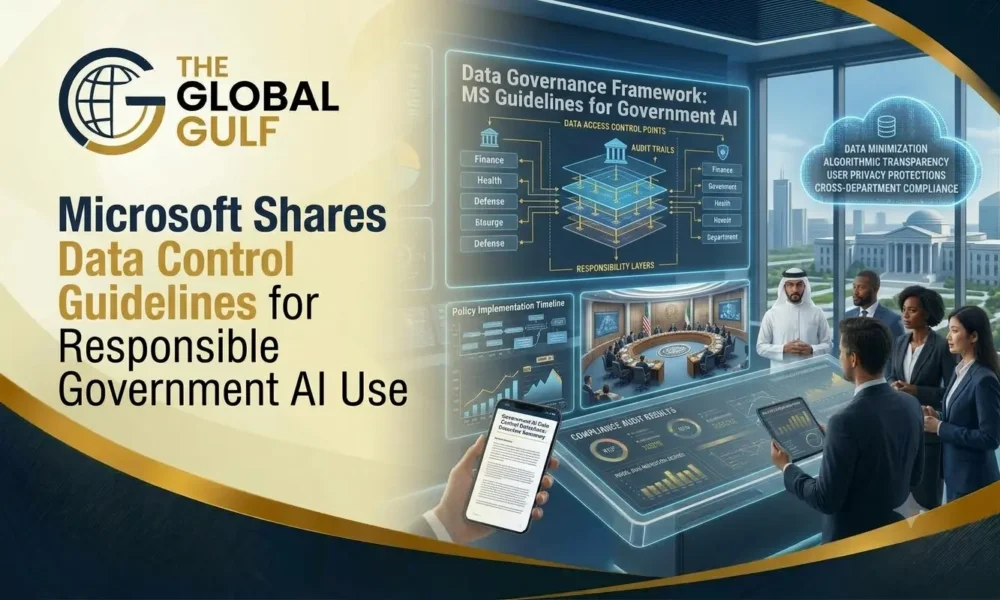
Microsoft’s 2026 Digital Defense Report offers public bodies a set of recommendations for adopting automated, machine-assisted tools while keeping control over sensitive information. The proposals include tight data controls, testing at the system level and shared security operations. Under the proposed model, agencies rely on a common, automated security service while each keeps its own isolated data environment. The recommendations tie deployment to access governance, accountable automation and workforce development.
Security Goes Beyond the Model
Terrell Cox, corporate vice president and deputy chief information security officer for customer security at Microsoft, said a model may be one component, but its security also depends on the data it can reach, the tools it can use, the identities and permissions involved, and the infrastructure and services around it.
For that reason, Microsoft advises governments to evaluate these systems in the environments where they actually run. That includes the interactions among models, tools, data and users, with monitoring continuing after launch.
Tracking Tools and Protecting Data
Managing deployments means keeping track of approved tools alongside unapproved software, with access rules scaled to how sensitive the data is. Prompts, query logs, stored memory and generated text all fall under those limits, because each can hold confidential records.
Any automated agent working across interfaces or separate applications needs an auditable identity record. The entry should show who built it, what tasks it performs and which human sponsor answers for it. Permissions should stay narrow. Credentials should expire on a fixed schedule, apply only to the immediate job and be reviewed whenever the agent’s scope changes.
The controls reach down to individual tool calls. Microsoft recommends short-lived credentials limited to a single use, authentication between agents, and measuring how quickly access is cut off after a compromise. These steps give administrators a way to trace actions and withdraw authority.
Guarding Stored Memory
Persistent memory needs its own safeguards. Microsoft’s red team reports that instructions hidden in outside content, commonly email, have shaped memory entries that were later retrieved as trusted context. The defensive design isolates the paths that write to memory, so that data pulled from outside cannot write directly into stores reserved for verified system rules.
The company also found that agents can mistake stored user habits for direct commands that govern safety rules. In internal tests, human confirmation screens failed when agents pointed to conflicting directives stored in memory to get past the prompt. Rather than relying on manual clicks, Microsoft advises hardcoded policy gates that block execution until a reviewer inspects the command alongside its raw operating context.
Shared Security Centres, Separate Data
Microsoft suggests building multi-tenant security operations centres across government. Central teams of analysts and automated agents would watch several public bodies at once, while each agency keeps its own cloud tenant, data residency controls and zero-trust boundary.
Central staff would sign in through delegated, short-term accounts with the lowest privileges needed, and all event logs would stay inside each agency’s own systems. Microsoft argues that pooling resources reduces duplicate software licenses and gives smaller public bodies access to specialist staff. The report, however, offers no data confirming actual cost savings in government.
Automated agents handle alert context gathering and threat summaries on their own, a routine Microsoft applies to 75 percent of its internal security incidents without human dispatch. Actions that disrupt live services, such as account lockouts, wait for administrator approval. Official breach notifications remain under manual executive control. Audit logs must record the data used for every action, the agent’s confidence score and notes from any supervisor who reviewed it.
Building the Workforce
To widen the pool of skilled defenders, Microsoft points to partnerships with community colleges, technical apprenticeships and university-run operations facilities. It also proposes mutual-aid response pacts that combine staff from local governments, federal cybersecurity offices, universities and volunteer response teams.
The company has begun trialling similar cross-agency structures abroad. Through its Advancing Regional Cybersecurity initiative, it ran pilot projects with Kenya’s National Computer and Cybercrime Coordination Committee before setting up exercises with Mexico’s Digital Transformation and Telecommunications Agency. Mexican agencies, technical teams and industry regulators ran incident-response drills to test operational handoffs ahead of the FIFA World Cup.
What to Watch
The recommendations try to balance pooled security resources with strict departmental independence. Agencies would share staff and automated tools but keep local control over data residency, memory-write rules and final incident decisions.
Key questions remain. Will governments adopt shared centres without weakening their control over data? Can the cost savings Microsoft describes be proven in practice? And how well will memory protections hold as attackers adapt? For public bodies weighing these tools, the report’s central message is practical: trust should rest on identity, limits, testing and human oversight, not on the model alone.
Also Read:
Qatar Urges Restraint as US and Iran Assert Control Over Hormuz
How the GCC Is Strengthening Its Position in Global Commerce


Related Articles

Anthropic Warns Hackers Are Using AI Agents for...
Cybercrime has always required patience: reconnaissance, careful probing, days or weeks of quiet groundwork before a breach pays off. That […]

Google Backs MIT Transit Lab With $2.1M for Nex...
MIT Transit Lab has secured $2.1 million from Google.org for its Public Transit Intelligence Hub, known as PTIQ, a platform […]
Google Introduces Gemini 3.8 Flash TTS for Smar...
Google has launched two Gemini 3.8 Flash TTS voice models, built for direct performance scripting and high-volume audio production. The […]
AMD and World Labs: What the Acquisition Means ...
AMD has agreed to acquire World Labs, the developer of the Marble world model, in an all-stock deal valued at […]