
 The Global Gulf |
 October 4, 2026 |
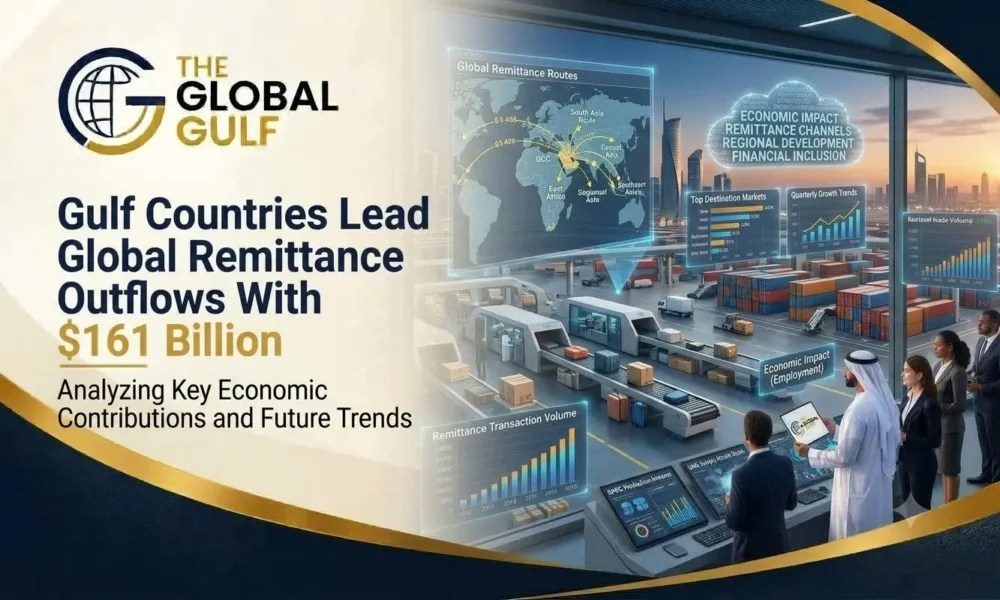
RIYADH: Gulf Cooperation Council countries recorded the highest value of outward workers’ remittances in the world in 2025, with transfers reaching about $161 billion, according to official data. The figure rose 13.6 percent from 2024, marking a second straight year of growth after outflows declined in 2023. The numbers come from GCC-Stat and were cited by the UAE’s state news agency, WAM.
A Rise Tied to Economic Growth
The increase in remittances has moved in step with the region’s economic expansion and its continued reliance on expatriate workers. The bloc’s population reached 63.3 million in 2025. Non-oil activities made up 70.6 percent of combined gross domestic product and grew 5.1 percent during the year.
As Gulf economies diversify, demand for labor has spread across a wider range of industries. Expatriate workers continue to support infrastructure, services, industry and other non-oil sectors, and that broader demand helps explain why money sent abroad keeps climbing.
How the Gulf Compares With Major Economies
WAM said the data highlights the exceptional global standing of the GCC when its total outgoing remittances are set against those of major economies individually. The bloc clearly outperformed the United States, whose remittances amounted to about $107 billion. Switzerland followed with about $43 billion, Germany with about $27 billion and France with about $21 billion.
Put another way, the Gulf’s combined outflows were roughly one and a half times those of the US and several times those of the leading European senders.
Remittances as a Share of GDP
Worker remittances accounted for about 6.6 percent of the GCC’s combined GDP in 2025. That is up from 6 percent in 2024, 5.7 percent in 2023 and 5.6 percent in 2022.
The report noted that this ratio measures the relative scale of remittance flows against the size of GCC economies. It should not be read as a direct measure of economic performance.
Support for Households Abroad
The value of these transfers goes beyond the money itself. Remittances support household incomes, consumer spending and economic stability in recipient countries. For many families in South Asia, Southeast Asia, Africa and other regions, money sent home by relatives working in the Gulf covers daily needs such as food, housing, education and health care. In some countries, these flows are a major source of foreign currency and a steady support for local economies.
The continued rise underscores the GCC’s growing role in global financial flows, while also reflecting the region’s expanding non-oil economy and its steady demand for expatriate workers.
Resilience Amid Disruption
The International Monetary Fund has said that economies with larger non-hydrocarbon sectors, including Bahrain, Saudi Arabia and the UAE, were better positioned to cushion the impact of recent disruptions. Weaker trade and business confidence, however, have held back activity.
That context matters for remittances. Because outflows follow employment and wages, they depend on how well Gulf economies keep creating jobs in non-oil industries. A diversified economy with strong construction, services, logistics and industrial sectors tends to sustain demand for workers, and with it the flow of money abroad.
What to Watch
Several factors will shape the figures in the coming years. Population growth and continued hiring will play a part, as will the pace of non-oil expansion and the effect of regional tensions on trade and business confidence. If diversification plans stay on track, the Gulf is likely to remain one of the world’s largest sources of remittances.
For now, the 2025 data shows a region whose economic model is closely linked to the people who build and run its economy. With outflows up 13.6 percent and the share of GDP edging higher for a third year running, the Gulf’s role as a global source of remittances looks set to remain central, with benefits reaching households far beyond its borders.
This article draws on data from GCC-Stat as reported by the UAE’s state news agency, WAM.
Also Read:
Qatar Urges Restraint as US and Iran Assert Control Over Hormuz
How the GCC Is Strengthening Its Position in Global Commerce

Related Articles
Central Banks of UAE and Syria Agree to Deepen ...
RIYADH: The central banks of the UAE and Syria have signed a memorandum of understanding on financial and technical cooperation, […]

Why Founders Should Prioritize Defensible Econo...
RIYADH: Founders seeking venture backing in Saudi Arabia should not position themselves in popular sectors simply to attract funding, according […]

Saudi Consumer Spending Tops $3 Billion Amid St...
Oil Slips Over 1 Percent as Hormuz Attacks Meet US Move to Ease Shipping Costs RIYADH: Oil prices fell more […]

India-Saudi Arabia Relations: A Complete 2025 T...
India Saudi Arabia relations have grown stronger every year, and 2025 turned out to be one of the busiest years […]