
 The Global Gulf |
 October 4, 2026 |
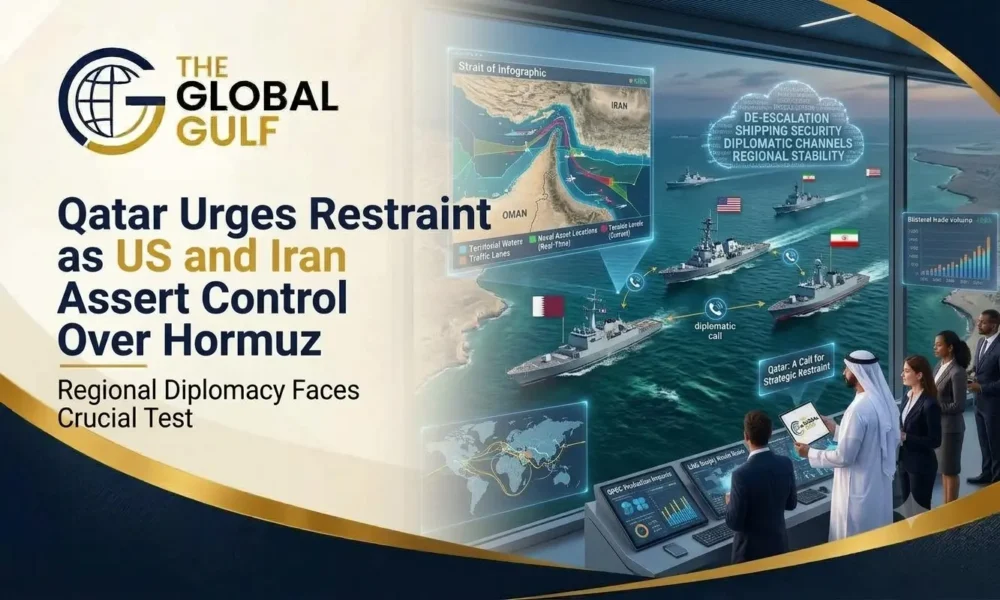
The war of words between the United States and Iran over control of the Strait of Hormuz has sharpened, as Qatar threw its support behind diplomatic efforts to end the seven-month conflict in the Middle East. At the same time, Saudi Arabia’s reopening of its East-West pipeline, which was temporarily shut this month after a drone attack, eased some market worries about oil supply.
Qatar Calls for Diplomacy
Qatari prime minister Sheikh Mohammed Al-Thani said on social media that his country is working to help Iran and the US reach a breakthrough. “We would like to see diplomacy as the way to resolve the strait issue,” he said on Wednesday. “Of course, it’s unacceptable to close the strait and to mine an international waterway.”
He described the waterway as a lifeline for Qatar and for the wider region, and said Doha is trying to find the best peaceful solution. In his words, there should be legal avenues that protect the rights of coastal states to free passage through the strait.
Talks Through Qatari Mediators
According to Reuters, Iran’s foreign minister Abbas Araghchi received US feedback on a proposed seven-day trust-building plan through Qatari mediators. The feedback is due to be discussed in Tehran today.
Even so, positions remain far apart. US president Donald Trump has said he has not offered Iran any sanctions relief or the release of frozen funds. Last week, Washington also imposed sanctions on Iranian airlines, which halted flights to the UAE and Oman.
Rival Claims Over the Strait
US Central Command rejected Tehran’s claim of full control over the waterway. In a social media post, it said Iran has no navy because American forces sank it. It added that thousands of ships, carrying more than 1 billion barrels of oil, have passed through freely over the past few months, which in its view shows Iran does not control the strait.
Iran’s account is very different. The state-backed news agency IRNA quoted army spokesman Mohammad Akrami-Nia as saying that Iranian order now prevails in the Strait of Hormuz. He called the passage an Iranian strategic asset and vowed to defend the country’s rights.
Oil Prices Stay Elevated
Despite the pipeline’s return, Brent crude futures rose 0.5 percent to $103.10 a barrel at 03:00 GMT, while WTI was flat at $89.44. Brent has gained 14 percent this month, its largest monthly rise since July, and WTI is up more than 4 percent. The spread between the two benchmarks widened in September to its highest level in four months.
The numbers suggest traders remain cautious. A restored pipeline helps with supply, but the dispute over shipping through Hormuz continues to keep a risk premium in prices.
Gulf Markets Slip
Most Gulf stock exchanges closed lower on Tuesday, weighed down by the stalemate over any peace plan. Saudi Arabia’s benchmark index fell 1.2 percent, and Aramco shares dropped more than 1 percent. Qatar’s market gauge lost more than 1 percent. Dubai and Abu Dhabi fell 0.2 percent and 0.3 percent respectively. Kuwait and Oman also ended lower, while Bahrain closed marginally higher.
Flights Between Iraq and Iran Resume
Elsewhere, Iraqi Airways resumed flights between Najaf and Iranian airports on Monday, according to the Iraqi News Agency. Iraq’s ambassador to Iran, Yasser Abdul-Zahra Al-Hajjaj, said the government never issued a decision to halt flights, adding that foreign ground-handling companies had stopped providing services out of fear of US sanctions.
What to Watch
Several questions will shape the days ahead. Tehran’s response to the US feedback on the trust-building plan is the most immediate. Whether Qatar can keep both sides engaged is another. Markets will also watch whether the Saudi pipeline keeps running smoothly, and whether any incident in or near the strait changes the picture again.
For now, diplomacy and confrontation are running side by side. Qatar’s message is that legal and peaceful routes remain open, while Washington and Tehran continue to trade claims about who controls one of the world’s most important energy passages. Until that dispute is settled, oil prices and Gulf markets are likely to stay sensitive to every new headline.
Also Read:


Related Articles

Saudi Ambassador to India: Full Profile and Lat...
Saudi Arabia and India share one of the strongest friendships in the Gulf region. A big part of that friendship […]
Iran Airlines Suspend Flights Amid Tougher US A...
TEHRAN — Iranian airlines have canceled a number of international flights after Washington moved to tighten sanctions targeting the country’s […]
US-Led Coalition Departure Sparks Concern Among...
ERBIL — As the deadline for the withdrawal of the US-led coalition from Iraq draws near, residents of Erbil are […]

MENA Sovereign Investment Faces Decline From Re...
Sovereign wealth funds in the Middle East are expected to deploy less capital this year than at their 2025 peak, […]