
 The Global Gulf |
 September 24, 2026 |
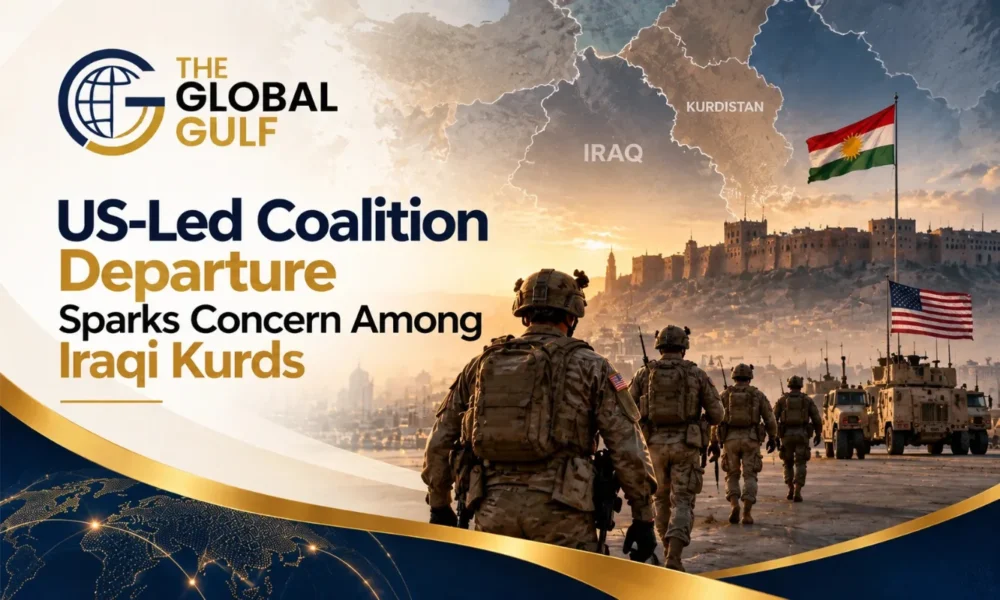
ERBIL — As the deadline for the withdrawal of the US-led coalition from Iraq draws near, residents of Erbil are voicing growing unease. Many say they are unsure who will step in to protect the autonomous Kurdistan region from the drone attacks that have repeatedly struck the area in recent years.
Baghdad and Washington reached an agreement in 2024 to gradually wind down the coalition’s mission against the Islamic State group in Iraq. That process has now reached its final stage. Coalition forces, once spread across multiple bases in the country, are down to a single remaining presence at Erbil airport. Their complete withdrawal is scheduled for September 30, following a year in which they steadily exited other positions throughout the region.
Fears on the Ground
For many in Erbil’s old bazaar, the coalition’s departure feels less like a diplomatic milestone and more like the removal of a safety net. Sherzad Farhadi, a 47 year old electronics shopkeeper, said he has little doubt the withdrawal will bring danger. He pointed to the region’s limited ability to defend itself against aerial threats, noting that missiles launched from Iran are simply beyond the reach of local defenses.
His concerns are shared by others in the market. Hashem Saeed, a 62 year old rosary vendor, questioned how drones and missiles would be intercepted without American support, arguing that local weaponry is not equipped to bring them down.
These worries are not abstract. Over the past several years, coalition forces have shot down numerous explosive laden drones and missiles over the Kurdistan region. Some of these attacks targeted coalition bases directly, while others struck unrelated sites, including oil facilities. Kurdish officials have largely attributed the strikes to armed groups backed by Tehran.
The intensity of these attacks rose sharply during the broader Middle East conflict, when Iran and its allied factions ramped up strikes against US-led forces and against exiled Iranian Kurdish opposition groups. Some of those drones reached deep into Erbil itself, striking buildings in the heart of the city and bringing the conflict uncomfortably close to civilian life.
A Mission That Outlasted Its Original Purpose
The coalition first arrived in Iraq and Syria back in 2014, deployed to confront the Islamic State group after it had overrun large stretches of both countries and carried out widespread atrocities. The group suffered military defeat in Iraq in 2017 and in Syria in 2019, but coalition forces remained afterward to continue operations against remaining pockets of the group’s fighters. Earlier this year, the coalition completed its withdrawal from Syria, setting the stage for the current exit from Iraq.
Farhadi, echoing concerns shared by others in the bazaar, warned that the Islamic State group could take advantage of the coalition’s absence to reemerge and destabilize the wider region once again, undoing years of hard-won security gains.
Divided Opinions Across Iraq
The coalition’s continued presence, particularly in the years following the defeat of the Islamic State group, has long been a source of friction between Iraqi authorities and Tehran-aligned armed factions operating within the country. That tension has shaped how different communities view the upcoming withdrawal.
Not everyone in Erbil sees the departure as purely negative. Zeravan Saeed, a 41 year old electronics vendor, suggested that the coalition’s exit could actually reduce the justification armed factions have used to target Kurdistan in the first place. In his view, removing that pretext for attacks could ultimately work in the region’s favor.
The mood shifts noticeably in Baghdad, where many view the withdrawal through a different lens entirely. On the bustling street of Karada, resident Abdullah al-Kinani argued that true sovereignty cannot be achieved until every foreign military presence has left Iraqi soil, reflecting a sentiment held by many in the capital who see the coalition’s exit as a long overdue step toward full independence.
That sentiment has found official backing as well. Iraqi Prime Minister Ali al-Zaidi has declared that October 1, the day immediately following the coalition’s departure, should be marked and celebrated as Sovereignty Day, framing the withdrawal as a defining moment in the country’s post-conflict history.
A Region at a Crossroads
As the September 30 deadline approaches, Iraq finds itself caught between two competing narratives. For residents of Baghdad, the coalition’s exit represents the long-awaited restoration of full national sovereignty. For many in Erbil, it raises pressing and unanswered questions about security, protection, and what comes next for a region that has repeatedly found itself in the crosshairs of regional conflict.
Whether the withdrawal ultimately eases tensions, as some in Kurdistan hope, or opens the door to renewed instability, as others fear, remains to be seen in the weeks and months that follow.

Related Articles

How the GCC Is Navigating the New Paradigm of O...
The US-Israeli military campaign against Iran, known as Epic Fury, has triggered what analysts describe as the worst oil supply […]

MENA Sovereign Investment Faces Decline From Re...
Sovereign wealth funds in the Middle East are expected to deploy less capital this year than at their 2025 peak, […]

Gulf States Strengthen Strategic Ties With Wash...
The red-carpet welcome given to Chinese leader Xi Jinping in Washington last week stood in contrast to the modest policy […]
Qatar Urges Restraint as US and Iran Assert Con...
The war of words between the United States and Iran over control of the Strait of Hormuz has sharpened, as […]