
 The Global Gulf |
 September 24, 2026 |
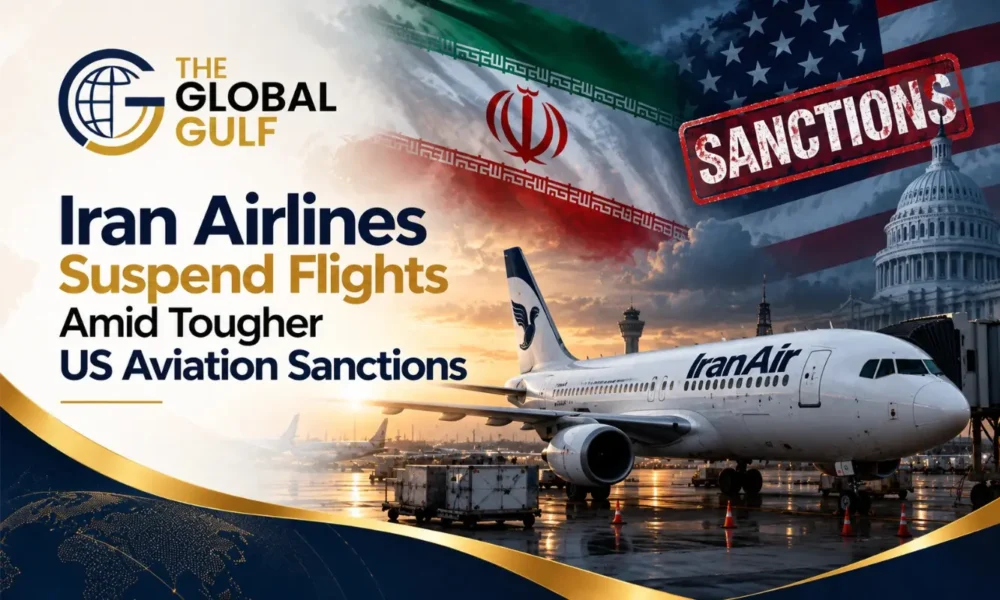
TEHRAN — Iranian airlines have canceled a number of international flights after Washington moved to tighten sanctions targeting the country’s aviation sector, marking a fresh escalation in economic pressure between the two nations.
Widespread Disruption to Regional Routes
The impact of the new measures has rippled across several key travel corridors. Flights to and from Georgia and Azerbaijan have been suspended entirely, cutting off routes that many Iranian travelers and businesses have relied on for regional connectivity. Beyond the South Caucasus, the disruption has extended further, affecting flights to Baghdad, Muscat, Qatar, and the United Arab Emirates, all major hubs for Iranian air traffic within the wider Middle East.
For airlines already navigating a difficult operating environment, the suspension of these routes represents a significant setback. Iran’s aviation sector has long struggled under the weight of sanctions, facing challenges in sourcing aircraft parts, securing insurance, and maintaining the kind of international partnerships that keep commercial fleets running smoothly. The latest measures add another layer of difficulty to an industry already stretched thin.
Washington’s Position
US Treasury Secretary Scott Bessent confirmed that the tightened restrictions are a deliberate part of a broader strategy aimed at increasing economic pressure on Tehran. The move fits within a longer pattern of sanctions the United States has used over the years to target sectors of the Iranian economy considered vital to the government’s operations and revenue streams, with aviation now squarely back in focus.
By restricting the aviation sector specifically, the measures appear designed to limit Iran’s ability to maintain international air links, a step that could have ripple effects not just for commercial travel but for trade, tourism, and the broader movement of people in and out of the country.
Tehran’s Response
Iranian President Masoud Pezeshkian struck a defiant tone in response to the announcement, stating that the sanctions would only serve to strengthen Iran’s resolve in resisting pressure from Washington. His comments reflect a familiar stance from Iranian leadership, one that has consistently framed external economic pressure as an obstacle to overcome rather than a deterrent to change course.
Iran’s government did not stop at rhetoric alone. Officials issued a pointed warning to neighboring countries, cautioning them against complying with the newly imposed sanctions. Tehran further signaled that it would consider reciprocal action against nations that choose to enforce the restrictions, raising the possibility of a wider regional standoff extending beyond the immediate aviation disruptions.
A Familiar Pattern of Pressure and Pushback
The current standoff echoes a long running dynamic between Iran and the United States, one marked by cycles of sanctions, defiant responses, and diplomatic tension that has spanned multiple administrations on both sides. Aviation has periodically served as a flashpoint in this relationship, given its visibility and its practical impact on ordinary citizens who rely on air travel for work, family visits, and business.
The suspension of flights to countries like Qatar and the UAE is particularly notable, as both nations serve as major regional transit points connecting Iran to the broader world. Disruptions along these routes could complicate travel plans for thousands of passengers and create additional friction in Iran’s already complex web of regional relationships.
Regional Ripple Effects
For neighboring countries like Georgia and Azerbaijan, the suspension of direct flights removes a travel option that has served both business and personal connections between these nations and Iran. The decision to halt these routes, whether driven by the airlines themselves in response to the sanctions or by broader compliance concerns, underscores how quickly aviation policy can shift the practical realities of cross-border movement.
Baghdad’s inclusion on the list of affected routes is especially significant given the close economic and political ties between Iraq and Iran. Any disruption to this corridor has the potential to affect not just travelers but broader trade and diplomatic engagement between the two neighbors.
What Comes Next
As the situation develops, much will depend on how neighboring countries respond to Iran’s warning against compliance with the sanctions. Should nations in the region choose to maintain their own restrictions in line with Washington’s measures, Tehran’s threat of reciprocal action could introduce further uncertainty into an already strained web of regional relationships.
For now, Iranian travelers and businesses are left navigating a shrinking map of available international routes, while officials in Tehran continue to project defiance in the face of mounting economic pressure. Whether this latest round of sanctions achieves its intended effect or simply deepens the standoff remains an open question, one that will likely play out in the coming weeks as both sides weigh their next moves.

Related Articles

How the GCC Is Navigating the New Paradigm of O...
The US-Israeli military campaign against Iran, known as Epic Fury, has triggered what analysts describe as the worst oil supply […]

How the GCC Is Strengthening Its Position in Gl...
A structural realignment is reshaping global corporate banking. As many international lenders grow more restrictive in deploying capital, highly liquid […]
Qatar Urges Restraint as US and Iran Assert Con...
The war of words between the United States and Iran over control of the Strait of Hormuz has sharpened, as […]

India-Saudi Arabia Relations: A Complete 2025 T...
India Saudi Arabia relations have grown stronger every year, and 2025 turned out to be one of the busiest years […]