
 The Global Gulf |
 October 4, 2026 |
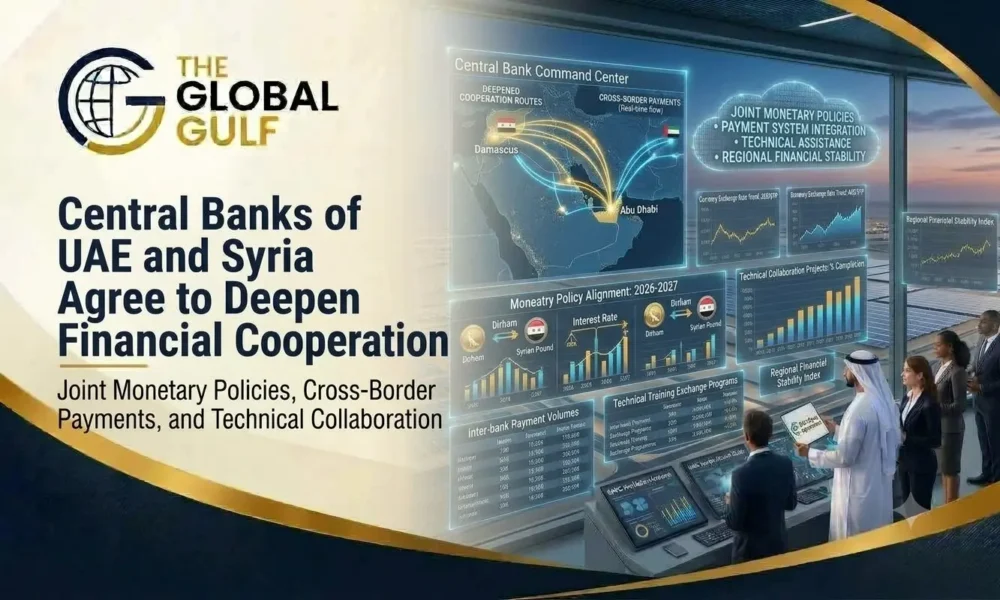
RIYADH: The central banks of the UAE and Syria have signed a memorandum of understanding on financial and technical cooperation, as the two countries look to strengthen banking ties and share regulatory expertise. The agreement was signed by Khaled Mohamed Balama, governor of the Central Bank of the UAE, and Mohammad Safwat Abdel Hamid Raslan, governor of the Central Bank of Syria, according to the Emirates News Agency, WAM.
A Framework for Shared Expertise
The memorandum sets out a framework for cooperation on institutional capacity building, technical expertise and regulatory frameworks. Under it, the two central banks will exchange knowledge in areas of mutual interest.
The scope is wide. The agreement covers payment systems, monetary policy, cash management and innovative financial technologies, along with climate-risk management and sustainable finance. It also includes financial inclusion, financial literacy, credit information systems, and reporting and risk-management frameworks. In addition, the two institutions will share experience on licensing financial activities and institutions, regulatory enforcement, compliance and consumer protection.
What the UAE Says
In a press statement, Balama said the memorandum reflects a shared interest in advancing cooperation in financial and regulatory areas. He described the aim as supporting the resilience of the financial system, improving the efficiency of financial infrastructure and keeping pace with developments in financial technology.
He added that the cooperation could open broader opportunities for financial institutions in both countries and strengthen the sector’s role in supporting economic growth and development.
What Syria Hopes to Gain
Raslan said the agreement would support deeper cooperation in banking supervision and regulation, payment and transfer systems, and the development of banking infrastructure. He said Syria attaches particular importance to the chance to advance financial inclusion, build institutional capacity, and strengthen regulatory and supervisory frameworks.
In his view, the memorandum provides a foundation for practical cooperation that could improve banking services, support monetary and financial stability, and create wider openings for banking partnerships between Syria and the UAE.
Syria Works to Rebuild Its Banking Sector
The agreement comes as Syria seeks to expand its banking sector and attract foreign investment. In September, Raslan said foreign capital for establishing new banks was expected to exceed $1 billion, as the country works to restore links with international financial networks.
Interest from the region has been growing. According to the central bank, seven delegations have expressed interest in setting up banks in Syria. The bank has also been working to restore correspondent banking relationships and widen access to regional financial networks, which are essential for payments, trade finance and cross-border transfers.
Economic Ties Are Deepening
The memorandum also follows a broader strengthening of relations between the two countries. In May, the first Syrian-Emirati Investment Forum took place in Damascus, bringing together officials and business leaders to discuss opportunities in tourism, real estate, agriculture, energy, aviation, logistics, healthcare and technology.
Taken together, these steps point to a steady effort to build commercial and financial links, with central bank cooperation serving as a base for more private-sector activity.
Why It Matters
For Syria, reconnecting with global and regional financial systems is a priority. Strong regulation, modern payment systems and reliable supervision help build trust among foreign banks and investors. Access to the experience of a well-established regulator such as the UAE’s central bank could help speed up that process.
For the UAE, the agreement adds to its network of financial partnerships and supports its role as a regional hub for banking and trade. Closer ties with Syria may also create openings for UAE financial institutions as the Syrian market develops.
What to Watch
Much will depend on how the memorandum is put into practice. Key signs to follow include training programs, joint work on payment systems, progress on licensing new banks and the restoration of correspondent banking links. The pace of foreign capital entering the sector will also be a useful measure of confidence.
The agreement marks another step in efforts to strengthen financial and economic links between the two countries, as Syria works to develop its banking infrastructure and integrate more closely with regional financial markets.
Also Read:
Qatar Urges Restraint as US and Iran Assert Control Over Hormuz
How the GCC Is Strengthening Its Position in Global Commerce


Related Articles

Gulf Countries Lead Global Remittance Outflows ...
RIYADH: Gulf Cooperation Council countries recorded the highest value of outward workers’ remittances in the world in 2025, with transfers […]

Why Founders Should Prioritize Defensible Econo...
RIYADH: Founders seeking venture backing in Saudi Arabia should not position themselves in popular sectors simply to attract funding, according […]

Dubai Customs Announces 60-Day Extension of Cus...
DUBAI — Dubai Customs has extended the suspension period for customs duties on eligible declarations by an additional 60 days, […]

Saudi Consumer Spending Tops $3 Billion Amid St...
Oil Slips Over 1 Percent as Hormuz Attacks Meet US Move to Ease Shipping Costs RIYADH: Oil prices fell more […]