

 The Global Gulf |
 October 4, 2026 |
RIYADH: Founders seeking venture backing in Saudi Arabia should not position themselves in popular sectors simply to attract funding, according to Latifa BaNasr, partner at Saudi investment firm Sharaka Capital. Speaking to Arab News, she said entrepreneurs should not rush toward fintech or artificial intelligence unless they can show they understand an overlooked market problem and can build durable economics around it.
Why Founders Chase Fashionable Sectors
The concentration of Saudi venture funding helps explain the pull. A Saudi Venture Capital analysis covering 2018 to November 2025 found that fintech attracted almost $4 billion, with payment solutions making up about 72 percent of that total. MAGNiTT reported that fintech received 80 percent of the capital deployed in the first quarter of 2026, even though gaming led by deal count.
“Don’t go for a category that is just big and attractive,” BaNasr said. “It’s preferable that you have an experience in it.”
Insight Before Category
BaNasr separates market size from market structure. A large pool of spending with weak economics can be less investable than a smaller segment that can grow through pricing power, network effects or high switching costs. Founders, she said, should look for neglected subsegments that can become markets in their own right.
She asked a simple question of every founder: what do they understand about the industry, the problem and the market that others, including investors, do not?
Within fintech, Sharaka considers payments and robo-advisory highly competitive. Its areas of interest include financial infrastructure and embedded finance. The firm is also looking at vertical software-as-a-service businesses, applied AI, cybersecurity, property technology and gaming monetization. For AI companies, BaNasr said the technology must create a genuine moat rather than serve as “just a tag.”
Build a Repeatable Engine
Choosing a sector is only the start. Founders must show a sustainable, repeatable economic engine, where customers see enough value to stay and potentially pay more as the product matures. BaNasr said the firm wants a product core or technology that creates a measurable advantage and strengthens over time instead of shrinking.
For entrepreneurs, this moves the fundraising pitch away from a broad total addressable market and toward evidence of defensibility. Investors want to know who holds pricing power, how regulation affects entry, whether customers face real switching costs and why the business gets stronger as it scales.
Learn Faster Than Evidence Changes
Conviction matters, but BaNasr cautioned that founders must not let commitment to their vision override contradictory evidence. “We like resistance,” she said. “However, what we don’t like is a founder who cannot see what reality is.”
The quality she most wants in every early-stage founder is speed of learning paired with intellectual humility. That combination helps operators make hard trade-offs, pivot into better markets, repair governance problems and attract stronger talent.
Experience is becoming more visible in the Kingdom’s pipeline. An SVC report examining 400 Saudi founders found that 36 percent had more than 10 years of professional experience, which supports BaNasr’s observation that more serial entrepreneurs and former operators are entering the market.
Turn Boards Into Working Sessions
Some post-investment problems come less from the product than from weak governance. Boards can become forums for status reports and budget approvals when they should be identifying the most consequential problem and deciding how to tackle it. Founders may also spend too much energy managing boardroom dynamics instead of drawing useful insight from directors.
Investors, BaNasr said, should diagnose whether a company needs a better board process, specialist coaching or targeted commercial support. They should also ask whether their own intervention created a new risk. She gave the example of an investor introducing a major customer that later accounts for 60 percent of revenue. The sale brings growth, but it also creates customer concentration that both sides must address.
Sharaka does not typically lose conviction within six months when difficulties emerge. At the early stage, worrying patterns can take two or three years to become clear, giving founders and investors time to find the cause and attempt a fix.
Learn in Your Biggest Market
BaNasr said Saudi deal flow increasingly includes serial founders and former operators who have gained experience through both exits and failures. She also sees an advantage in companies that start in the Kingdom before expanding regionally or globally. Building first in the largest market gives founders direct exposure to local customers. A business developed elsewhere may arrive with assumptions shaped by different consumer behavior, requiring more capital and time to relearn the market.
What Founders Can Take Away
The message is practical. Pick a problem you know well, not a category simply because money is flowing into it. Show why your economics improve with scale, listen to evidence even when it challenges your plan, and treat your board as a working partner.
Sharaka Capital runs two venture funds. The first is fully deployed after the firm began investing in 2019, and the second launched in 2025. The firm has invested in multiple companies and is actively seeking MENA founders raising seed or series A rounds. It is also looking to engage growth-capital investors and companies developing liquidity or secondary-market solutions.
Also Read:
Qatar Urges Restraint as US and Iran Assert Control Over Hormuz
How the GCC Is Strengthening Its Position in Global Commerce
Related Articles
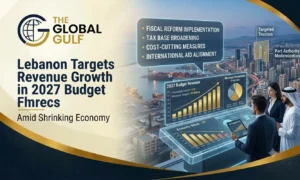
Lebanon Targets Revenue Growth in 2027 Budget A...
BEIRUT: Lebanon’s 2027 budget asks a shrinking economy to deliver tax revenue more than double what it collected in 2024, […]

Gulf Countries Lead Global Remittance Outflows ...
RIYADH: Gulf Cooperation Council countries recorded the highest value of outward workers’ remittances in the world in 2025, with transfers […]
India-Saudi Arabia Relations: A Complete 2025 T...
India Saudi Arabia relations have grown stronger every year, and 2025 turned out to be one of the busiest years […]
Central Banks of UAE and Syria Agree to Deepen ...
RIYADH: The central banks of the UAE and Syria have signed a memorandum of understanding on financial and technical cooperation, […]