
 The Global Gulf |
 October 5, 2026 |
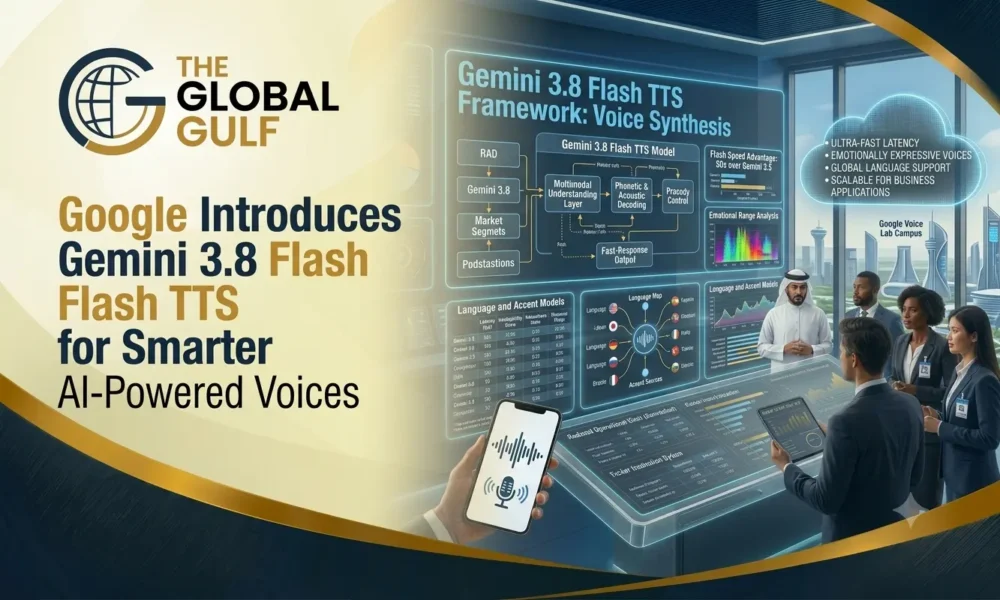
Google has launched two Gemini 3.8 Flash TTS voice models, built for direct performance scripting and high-volume audio production. The release splits speech generation between creative direction and cost-managed infrastructure.
Two Models, Two Purposes
Gemini 3.8 Flash TTS targets interactive entertainment, game development and long-form narration, where studio teams want to design a voice through written prompts. Gemini 3.8 Flash-Lite TTS focuses on automated media dubbing, customer-facing conversational agents and high-throughput translation pipelines.
Both join Google’s existing audio lineup, which previously included 3.5 Live Translate, 3.5 Transcribe, 3.8 Live and 3.8 Live Extended Thinking.
A Far Larger Voice Library
The new models replace a fixed catalogue of 30 legacy voices. Developers can now choose from more than 2,000 pre-built vocal profiles covering regional variations such as Quebec French, Scots English and Mexican Spanish, across more than 100 languages. A forthcoming voice remixing module will let audio engineers adjust timbre, pitch, pace and accent through direct text commands.
Benchmark Results
Independent evaluations place the larger model at the top of third-party rankings. On the Hume AI Voice Design Benchmark, Gemini 3.8 Flash TTS scored 71.4 overall, along with a category-leading 60.8 in accent modelling. In the Hume AI Overall Quality Index, it took first place, while Flash-Lite TTS came second, ahead of earlier baselines set by Gemini 3.1 Flash TTS.
Double-blind human trials run through Voice Arena also showed a preference for the new model in several languages, including Japanese, Brazilian Portuguese, Vietnamese, Modern Standard Arabic, Mexican Spanish and Hindi.
Built for Dialogue and Long Recordings
Multi-speaker staging and extended runs are a key focus. A single script can direct exchanges between two speakers, keeping natural turn-taking and clear vocal separation across long conversations. Audio quality and character timbre stay stable over multi-hour files, which reduces vocal drift in audiobooks and episodic podcasts.
Writers can place non-verbal markers directly in their text, using tags such as laughs, sigh or gasp. They can also add short verbal interjections like “mhm” and “yeah” to balance conversational pace.
Safeguards Against Misuse
Voice cloning requires mandatory identity checks to reduce impersonation risks. Recreating a voice needs a 30-second reference recording along with a spoken consent track from the original voice owner. Google checks that the two recordings match before processing a custom profile.
Generated files also carry an imperceptible SynthID audio watermark and cryptographic C2PA provenance metadata in the exported waveform, so downstream detection tools can identify synthetic speech.
Where It Is Available
Developers can reach both models through Google AI Studio and the standard Gemini API. They can also connect through frameworks run by Agora, LiveKit, Pipecat and Vercel. Early commercial users include Figma, HeyGen, Linguana, Wondercraft, 99.co and Ollang, which apply the models to regional media translation and customer service.
For everyday users, Flash TTS appears inside Gemini Notebook, while Google Vids uses Flash-Lite TTS. Gemini Enterprise customers will receive administrative API access in a later rollout.
What to Watch
The benchmark scores are encouraging, but real-world results will depend on how the voices perform in production. Studios and developers will want to test accent accuracy, long-form consistency and dubbing quality in their own projects. The remixing module, once released, could be an important test of how much creative control writers and audio engineers really gain.
For businesses, the split between the two models offers a practical choice: a richer, more expressive option for creative work, and a leaner one for volume. If the safeguards hold up, the release could make high-quality multilingual audio faster and cheaper to produce, while keeping clear signals about what is synthetic.
Also Read:
Qatar Urges Restraint as US and Iran Assert Control Over Hormuz
How the GCC Is Strengthening Its Position in Global Commerce


Related Articles

Google Backs MIT Transit Lab With $2.1M for Nex...
MIT Transit Lab has secured $2.1 million from Google.org for its Public Transit Intelligence Hub, known as PTIQ, a platform […]

India-Saudi Arabia Relations: A Complete 2025 T...
India Saudi Arabia relations have grown stronger every year, and 2025 turned out to be one of the busiest years […]

Microsoft Shares Data Control Guidelines for Re...
Microsoft’s 2026 Digital Defense Report offers public bodies a set of recommendations for adopting automated, machine-assisted tools while keeping control […]

Malaysia Deploys More AI Tools for Smarter Anti...
Malaysia’s anti-corruption agency is widening its use of data analytics and digital systems, along with automated analysis tools, as it […]